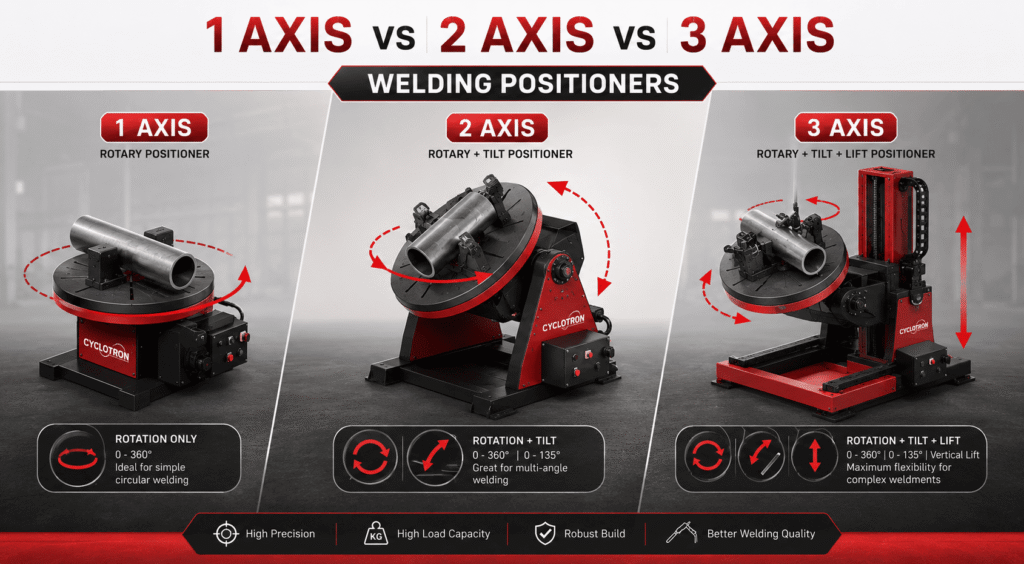
1 Axis vs 2 Axis vs 3 Axis Welding positioners
An easy explaination guide
As welding operations become demanding, more manufacturers are investing in welding positioners to improve productivity, consistency, and operator safety. These essential components of welding automation equipment help rotate and position workpieces so welders can maintain optimal welding angles throughout the process.
However, not all welding positioners offer the same level of movement. Some provide basic rotation, while others deliver advanced multi-directional positioning for complex fabrication projects. Choosing the wrong axis configuration can lead to unnecessary costs, reduced efficiency, and limited welding accessibility. Understanding the differences between 1-axis, 2-axis, and 3-axis welding positioners is the first step toward selecting the right solution for your operation.
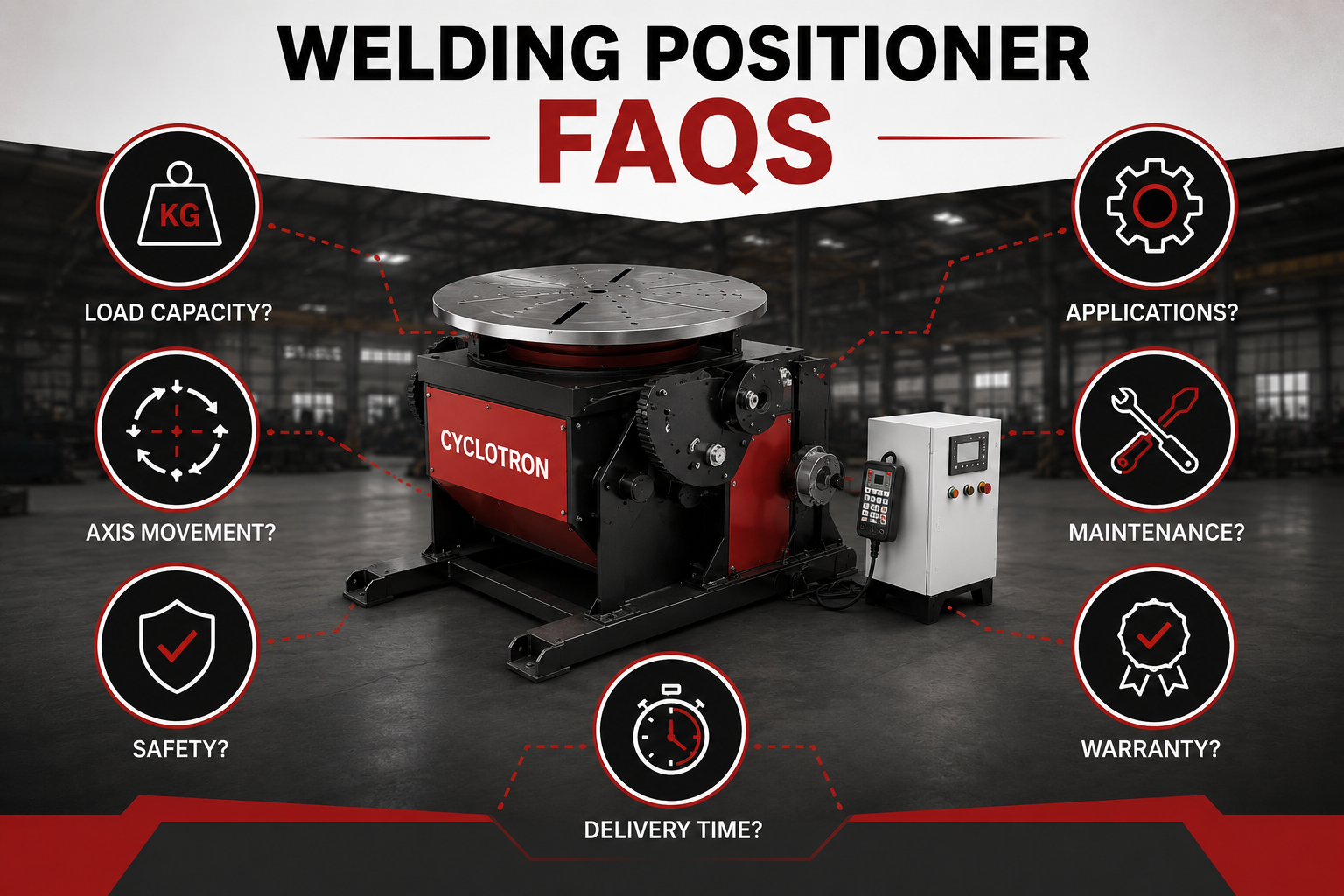
Cyclotron Welding Positioners from India
Cyclotron manufactures industrial welding positioners from 100 kg to 100 Tons capacity, designed for robotic/manual welding, heavy fabrication, and high-production welding environments.
- Cyclotron manufactures all types of Manual/Robotic welding positioners like 1 axis, 2 axis, 3 axis, Headstock-tailstock, L Type, skyhook, etc
What Does “Axis” Mean in a Welding Positioner?
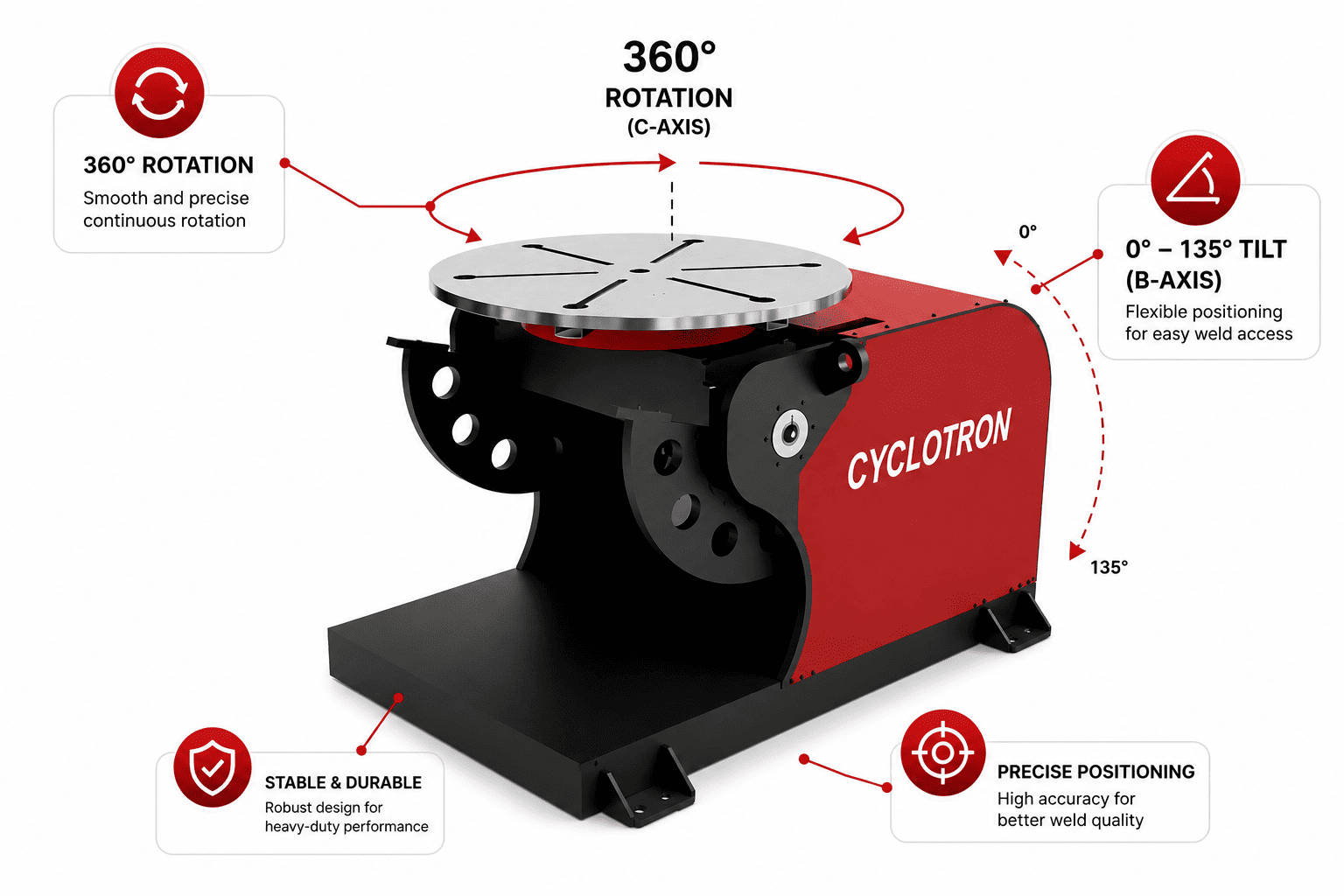
In welding positioners, an axis refers to a specific type of movement that allows a workpiece to be repositioned during welding. The more axes a positioner has, the greater its flexibility and control.
A welding positioner axis typically includes:
- Rotation Axis: Rotates the workpiece continuously around a central point.
- Tilt Axis: Tilts the workpiece to improve access to weld joints.
- Additional Positioning Axis: Provides extra movement for advanced positioning and automation applications.
A multi-axis welding positioner allows welders or robotic systems to access difficult weld locations while maintaining ideal welding positions, resulting in higher-quality welds and improved productivity.
What Is a 1-Axis Welding Positioner?
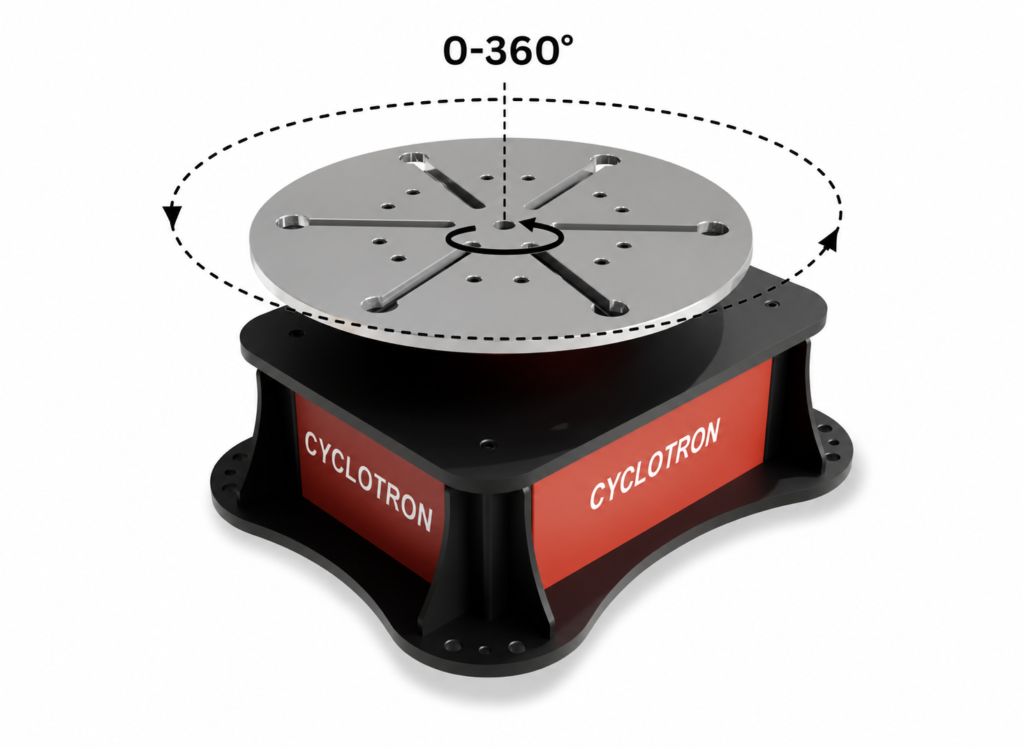
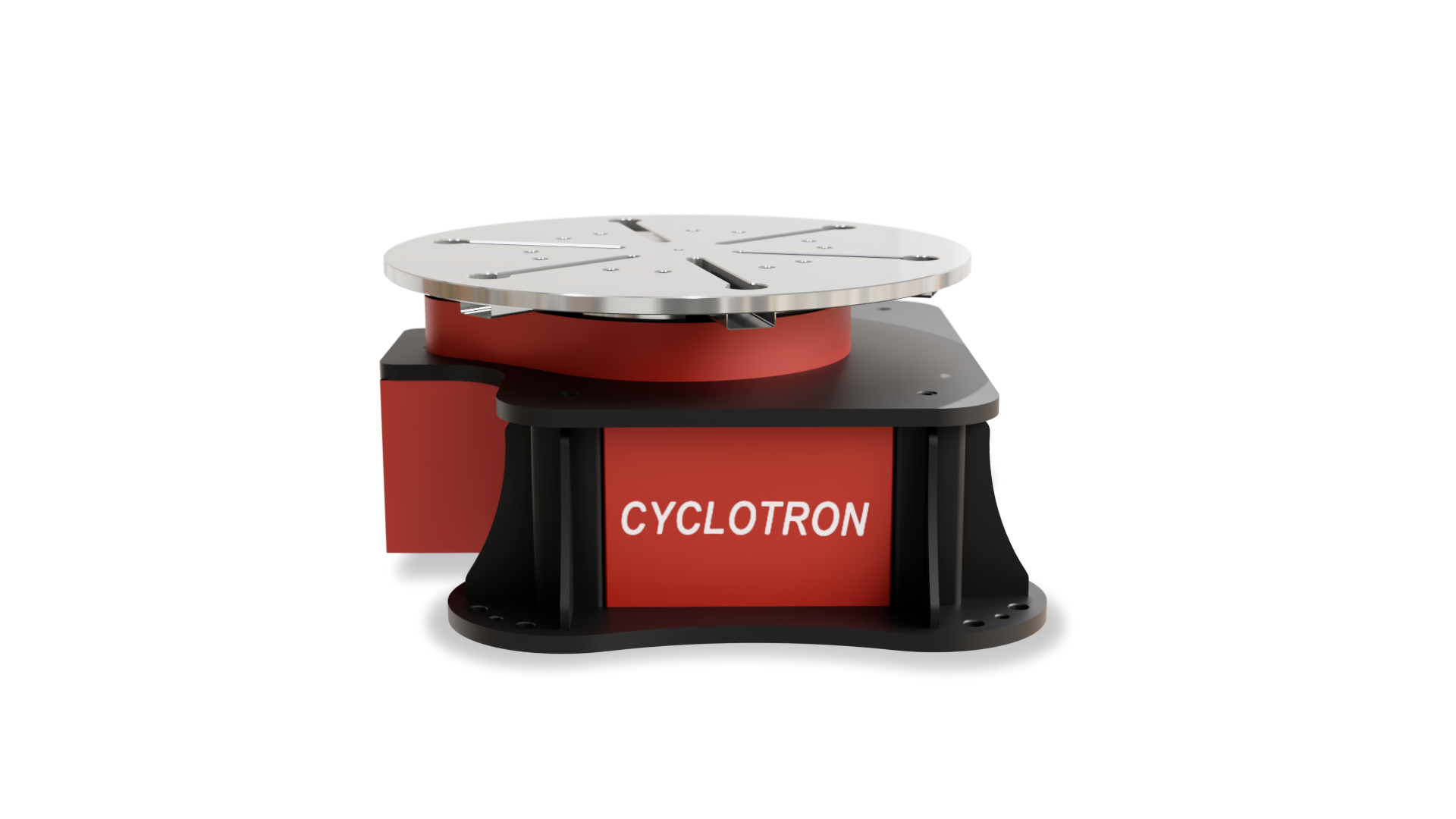
A 1 axis welding positioner provides a single movement: rotational motion. Often referred to as a welding turntable, this system rotates the workpiece around a fixed axis while keeping it in a stable position.
These positioners are ideal for simple welding applications where continuous rotation is sufficient. Common examples include pipes, flanges, cylindrical parts, and repetitive circular welds.
Common Applications
- Pipe welding
- Flange fabrication
- Small cylindrical components
- Repetitive rotational welding operations
Benefits
- Cost-effective solution
- Easy to operate
- Lower maintenance requirements
- Reliable for simple production tasks
For shops focused on straightforward welding jobs, a 1-axis system often provides all the functionality needed without unnecessary complexity.
What Is a 2-Axis Welding Positioner?
A 2 axis welding positioner combines rotational movement with tilt functionality. This tilt and rotate welding positioner configuration is the most widely used type in industrial fabrication because it offers significantly greater flexibility than a single-axis system.
By allowing both rotation and tilting, operators can position workpieces for better access to multiple weld joints while maintaining comfortable and ergonomic welding positions. This reduces the need for manual repositioning and improves overall weld consistency.
Common Applications
- Structural fabrication
- Medium and heavy fabrication projects
- Pressure vessel manufacturing
- Complex welded assemblies
Benefits
- Improved welding accessibility
- Better weld quality
- Reduced operator fatigue
- Less manual handling
- Increased production efficiency
For many fabrication shops, a 2 axis welding positioner provides the ideal balance between performance, flexibility, and cost.
Cyclotron Welding Positioners from India
Cyclotron manufactures industrial welding positioners from 100 kg to 100 Tons capacity, designed for robotic/manual welding, heavy fabrication, and high-production welding environments.
- Cyclotron manufactures all types of Manual/Robotic welding positioners like 1 axis, 2 axis, 3 axis, Headstock-tailstock, L Type, skyhook, etc
What Is a 3-Axis Welding Positioner?
A 3 axis welding positioner adds a third movement axis to the standard rotation and tilt functions. This additional positioning capability allows highly precise control over workpiece orientation and is commonly integrated into robotic welding systems and automated production environments.
These advanced positioners can handle complex geometries and challenging weld locations that would be difficult or impossible to reach using conventional positioning equipment.
Common Applications
- Aerospace fabrication
- Robotic welding cells
- Complex fabrication projects
- High-precision manufacturing operations
Benefits
- Maximum positioning flexibility
- Enhanced automation capability
- Greater weld accessibility
- Increased productivity
- Improved repeatability
While a robotic welding positioner typically requires a higher initial investment, it delivers substantial efficiency gains in demanding production environments
Main Differences Between 1-Axis, 2-Axis, and 3-Axis Welding Positioners
| Feature | 1-Axis | 2-Axis | 3-Axis |
|---|---|---|---|
| Rotation | Yes | Yes | Yes |
| Tilt Movement | No | Yes | Yes |
| Additional Positioning Axis | No | No | Yes |
| Flexibility | Basic | Moderate | Advanced |
| Cost | Low | Medium | High |
| Automation Capability | Limited | Moderate | High |
| Best For | Simple jobs | Industrial Fabrication | Complex Automation |
More axes allow better access to difficult weld locations, reducing setup time and improving welding efficiency. However, increased complexity also means higher equipment costs and more sophisticated control systems.
How to Choose the Right Welding Positioner
Selecting the right welding positioner depends on your production requirements, workpiece characteristics, and automation goals. Consider the following factors:
1. Job Complexity: Simple circular welds often require only rotational movement. Complex assemblies may need multiple positioning axes.
2. Number of Welding Angles: Projects involving numerous weld joints typically benefit from tilt and advanced positioning capabilities.
3.Workpiece Size and Weight: Larger components may require more robust positioning systems with enhanced movement control.
4. Production Volume: High-volume manufacturing environments often justify greater automation and flexibility.
5. Automation Requirements: Robotic welding applications frequently require 3-axis positioning for optimal performance.
6. Budget: While advanced systems offer greater capabilities, overbuying can increase costs without delivering meaningful benefits.
In many cases, a 2-axis system provides the best combination of flexibility and affordability. A 1-axis unit is sufficient for basic rotational welding. 3-axis systems become necessary for complex automated operations.
Industries Using Multi-Axis Welding Positioners
Multi-axis welding positioners are widely used across industries that demand high productivity and precision welding.
Common sectors include:
- Heavy fabrication
- Oil and gas
- Automotive manufacturing
- Aerospace
- Structural steel fabrication
- Wind energy production
As industrial welding automation continues to expand, more manufacturers are adopting advanced positioning systems to improve throughput and weld quality.
Conclusion
Choosing between a 1-axis, 2-axis, and 3-axis welding positioner comes down to the complexity of your welding applications and your production goals.
A 1-axis positioner is ideal for basic rotational welding tasks. A 2-axis system offers the best all-around solution for most fabrication shops, combining rotation and tilt for greater flexibility. A 3-axis positioner provides maximum accessibility and automation capability for complex, high-precision operations.
If you’re evaluating welding automation solutions, consult an experienced provider to determine the best welding positioner for your specific application. Explore advanced industrial welding automation systems to improve efficiency, quality, and long-term productivity.
Frequently Asked Questions
1. What is a 1-axis welding positioner?
A 1-axis welding positioner rotates a workpiece around a single axis and is commonly used for pipes, flanges, and other cylindrical welding applications.
2. What is the difference between 2-axis and 3-axis welding positioners?
A 2-axis positioner provides rotation and tilt movement. A 3-axis system adds an additional positioning axis for greater flexibility and automation.
3. Which welding positioner is best for pipe welding?
A 1-axis welding positioner or welding turntable is often sufficient for standard pipe welding applications involving continuous rotational welds.
4. Are 3-axis welding positioners used in robotic welding?
Yes. Many robotic welding systems use 3-axis welding positioners to achieve precise part positioning and improve automation efficiency.
5. Which welding positioner is most commonly used in fabrication shops?
The 2-axis welding positioner is the most commonly used configuration because it offers an excellent balance of flexibility, performance, and cost.
In this blog we will address all the commonly asked questions related to Welding positioners or Cyclotron Welding positioners specifically