Welding Positioner Capacity Calculation Guide
Simple Guide
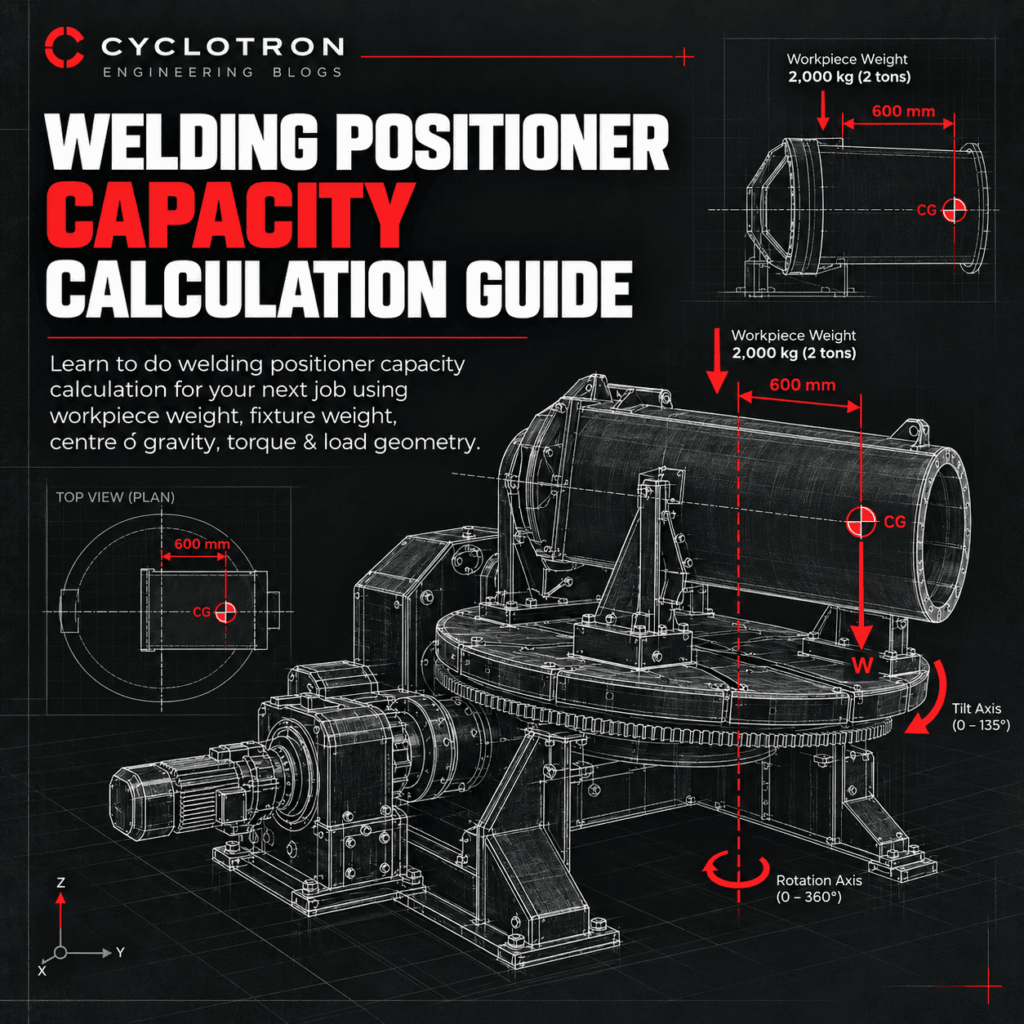
While doing a welding positioner capacity calculation, you should consider more than the weight of the workpiece. Proper positioner sizing evaluates all the critical factors like the combined workpiece and fixture load, centre of gravity, eccentricity, rotational and tilting torque, component geometry, required speed, duty cycle, and load-holding requirements.
Quick answer
The basic load calculation is:
Total operating load = (Workpiece + Fixture + Clamps + Tooling)*Factor of Safety
But that number obtained is only the starting point. A 5-tonne component that is well balanced around the rotation axis can impose a very different load on a positioner than a lighter component with a large CG (center of gravity) offset.
That distinction is where proper welding positioner sizing begins.
Here is how you do welding positioner capacity calculation for your project:
Cyclotron Welding Positioners from India
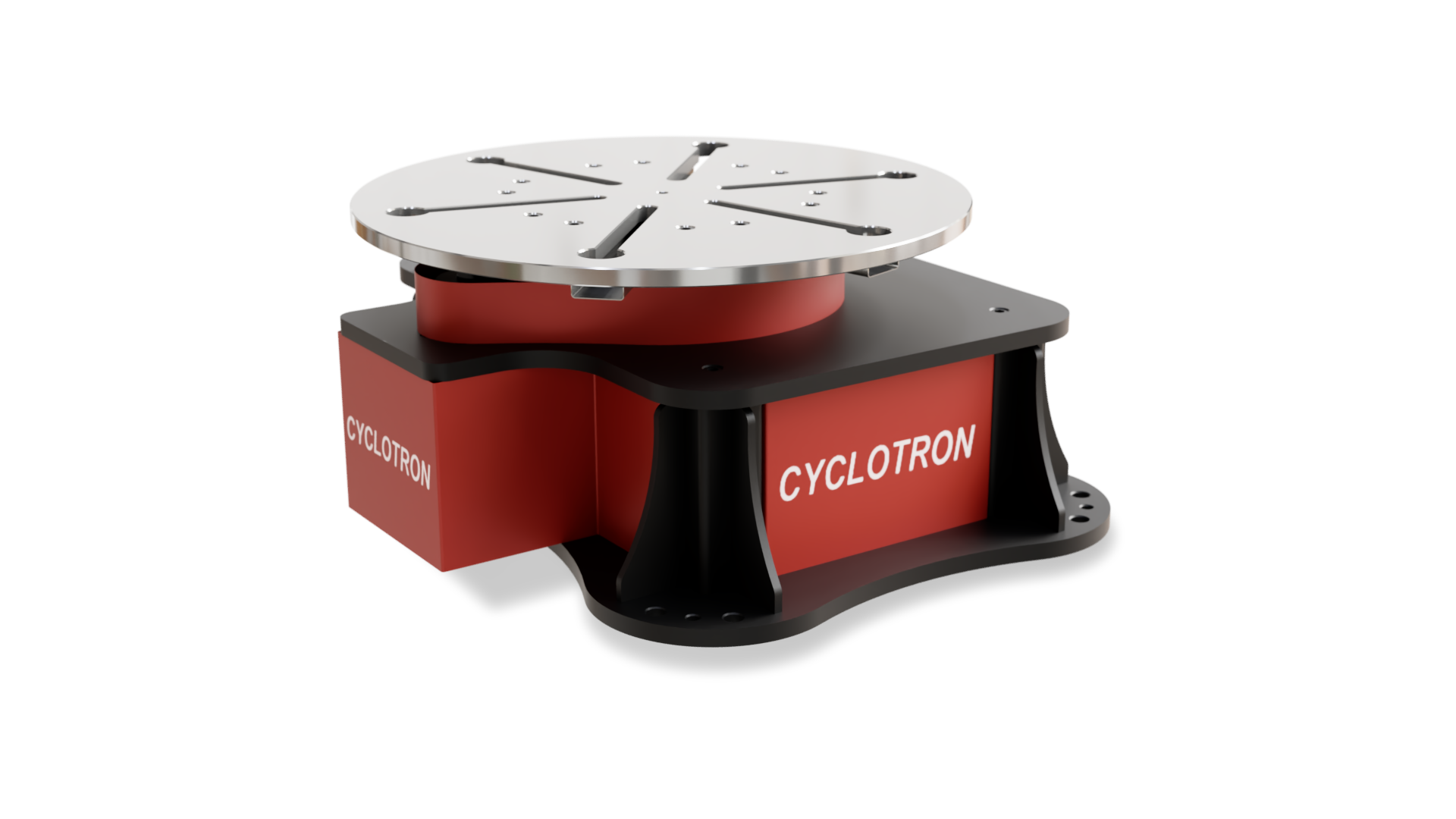
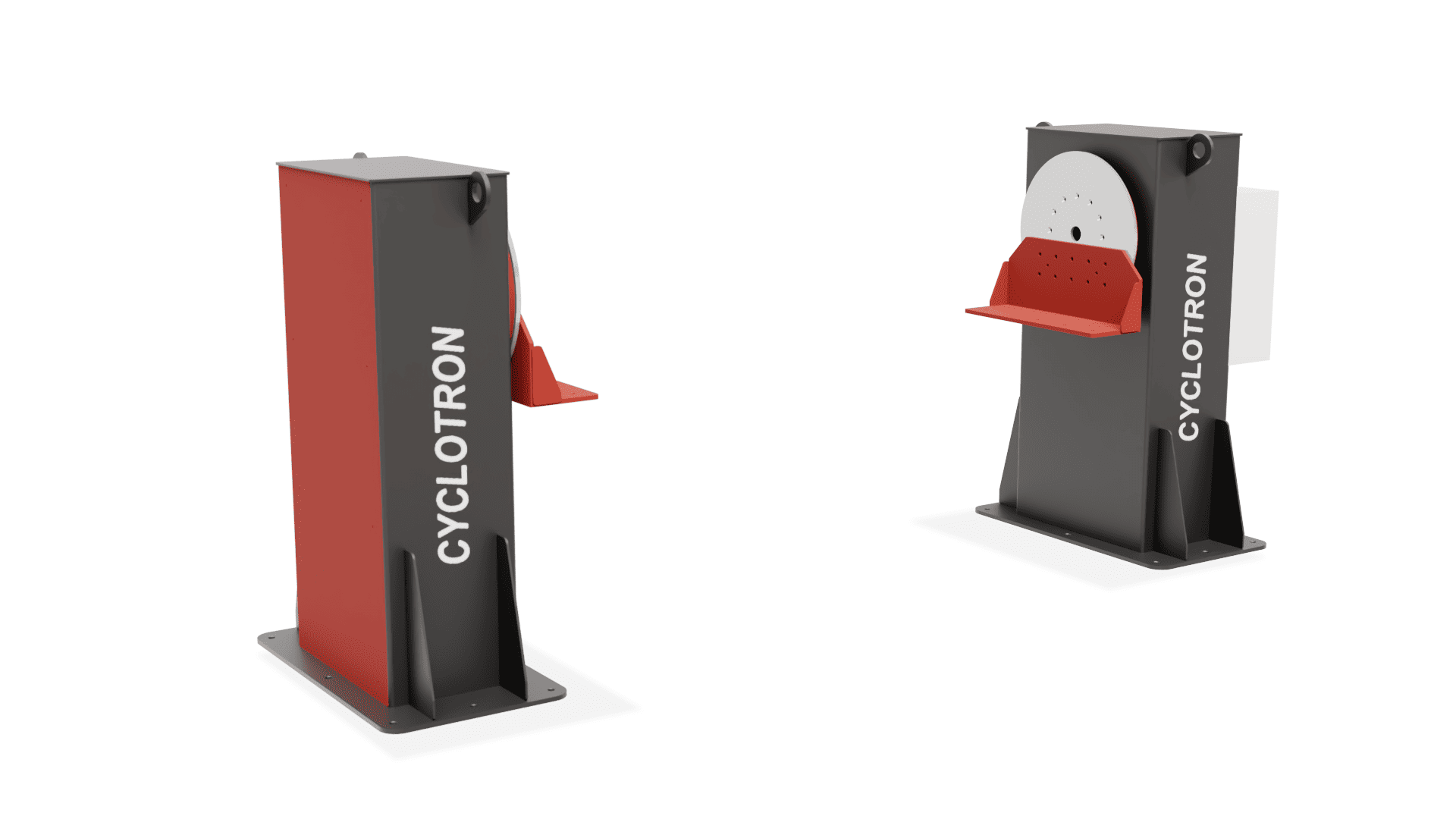
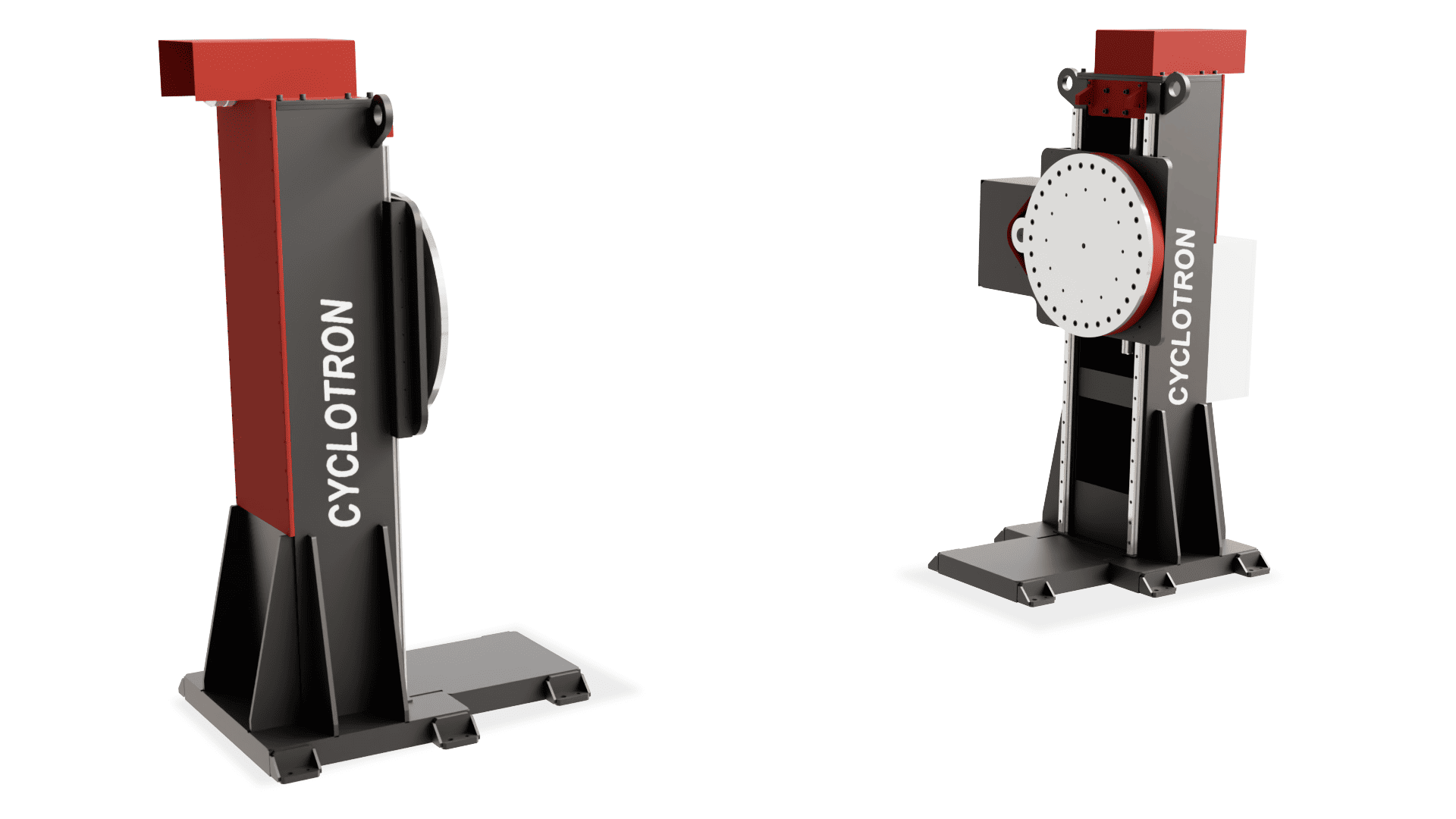
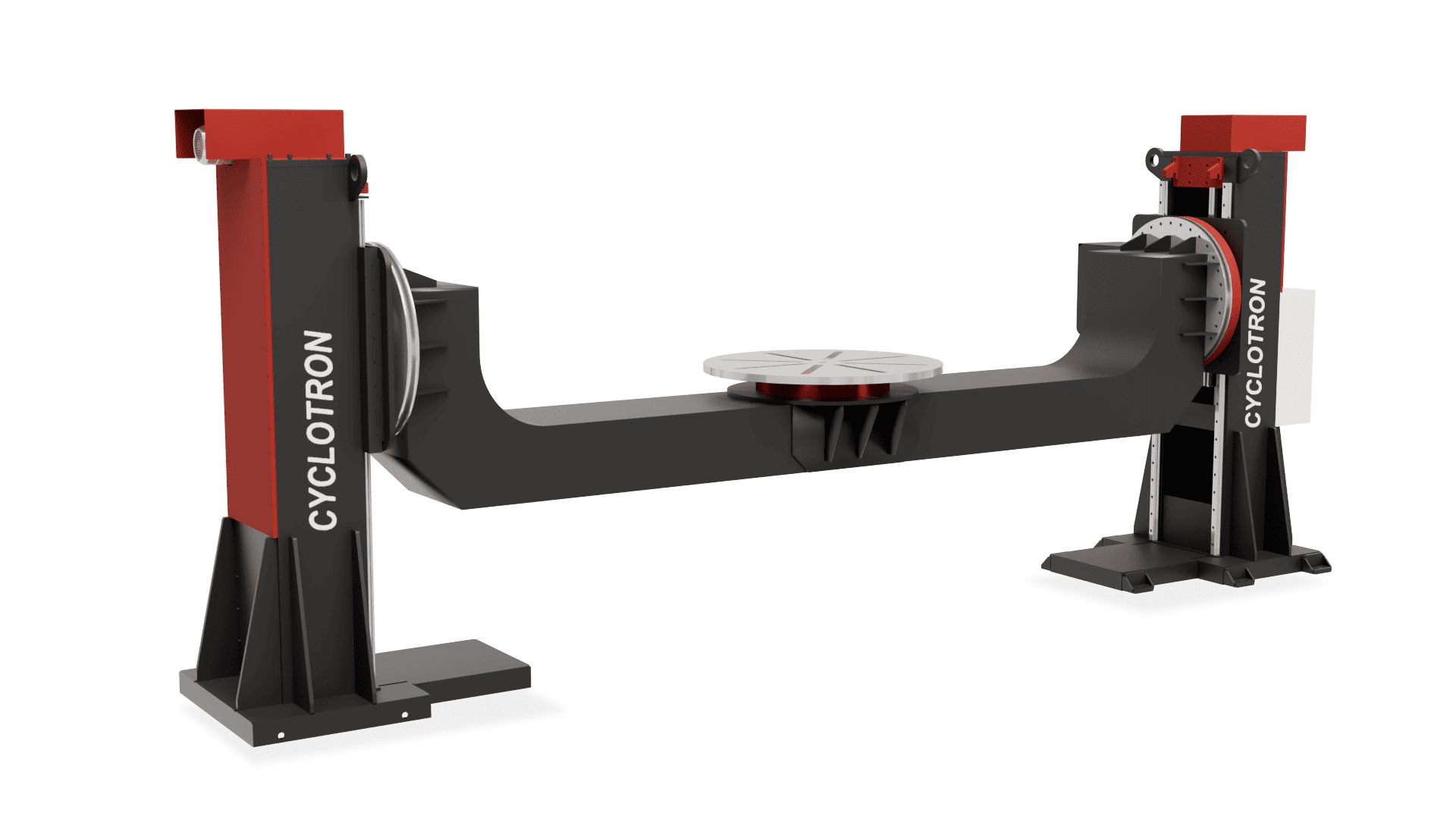
Cyclotron manufactures industrial welding positioners from 100 kg to 100 Tons capacity, designed for robotic/manual welding, heavy fabrication, and high-production welding environments.
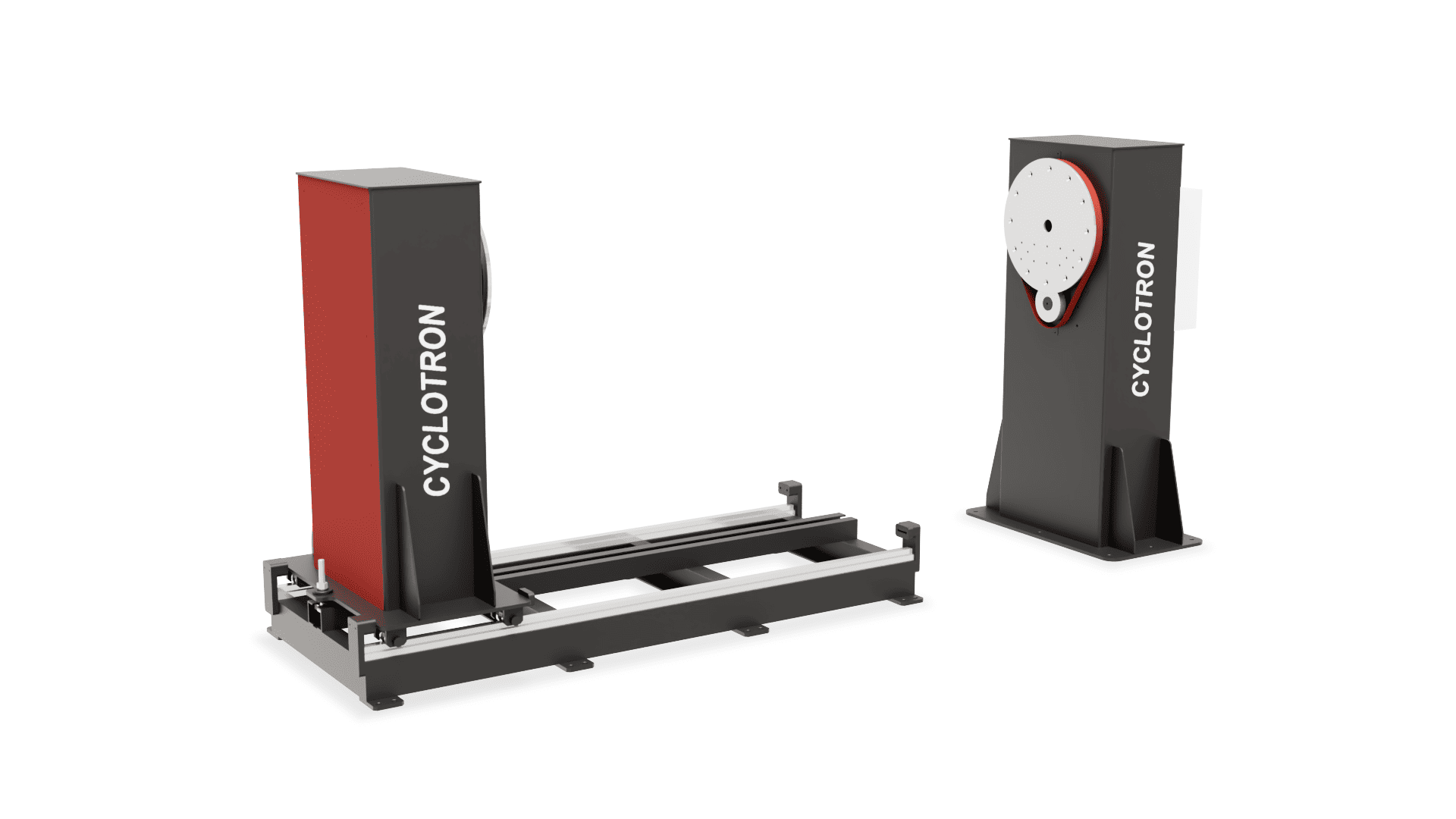
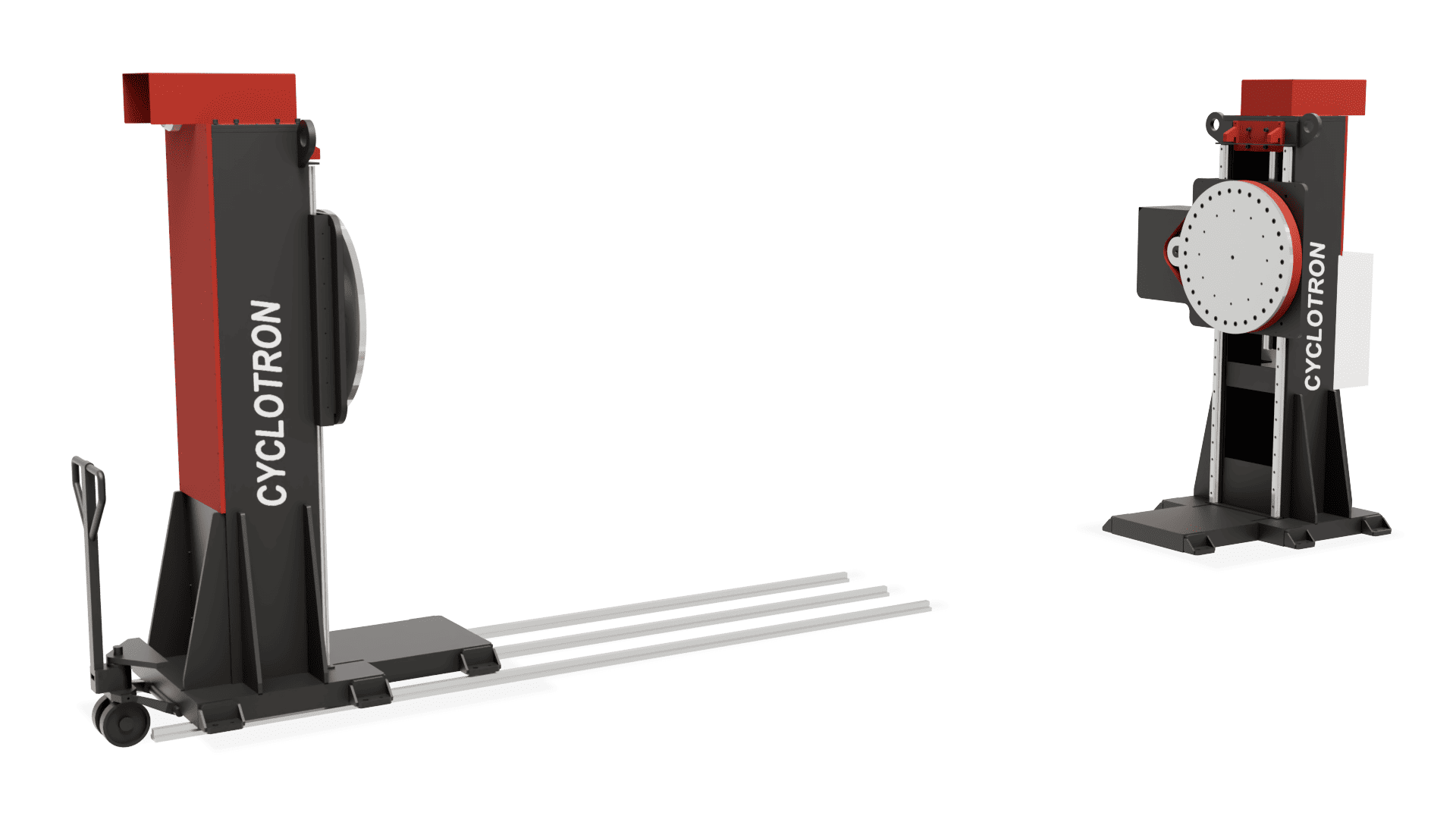
- Cyclotron manufactures all types of Manual/Robotic welding positioners like 1 axis, 2 axis, 3 axis, Headstock-tailstock, L Type, skyhook, etc
Step 1: How Do You Calculate the Total Positioner Load?
Start by calculating everything that will rotate or tilt with the positioner. This includes the workpiece itself, fixture, clamps, tooling, and any other permanent or removable equipment carried by the table.
Example:
- Workpiece: 4,000 kg
- Fixture: 600 kg
- Total operating load: 4,600 kg
So, if you select a nominal 4-tonne positioner simply because the workpiece weighs 4,000 kg, you are ignoring 600 kg of additional load.
That is not a minor detail. The fixture is part of the actual machine load whenever it moves with the workpiece.
For a real application, the calculation should therefore begin with the complete assembly and not just the fabrication on the drawing.
Step 2: How Does the Centre of Gravity Affect Welding Positioner Sizing?
The next question is: where is the centre of gravity relative to the positioner’s rotation and tilting axes?
Two assemblies can have exactly the same mass but place very different demands on the machine.
Record the CG location in the relevant X, Y, and Z directions and identify any radial offset or eccentricity from the axis of rotation.
For example, imagine two 4,000 kg fabrications. One has its mass concentrated close to the rotation axis. The other has a significant portion of its mass positioned away from that axis.
The second arrangement can create substantially greater mechanical loading and torque.
Weight tells you how much the assembly weighs. CG tells you how that weight acts on the machine.
Step 3: How Do You Calculate Rotational and Tilting Torque?
A basic engineering relationship for moment is:
Moment = Force × Perpendicular Distance
For a gravity-related load, the force comes from the weight of the assembly, and the relevant distance depends on the geometry and axis being evaluated.
This is why eccentricity is critical.
A load positioned away from the rotation or tilting axis creates a larger moment than the same load positioned close to it. The positioner thus needs adequate torque capability in addition to sufficient load capacity.
The exact calculation should consider the applicable axis, CG location, orientation, and operating condition.
Step 4: What Component Geometry Should You Check?
Even when the calculated weight appears acceptable, the physical envelope can create another limitation.
Review:
- Overall component length
- Diameter or width
- Overhang
- Swing radius
- Fixture dimensions
- Table size
- Floor clearance
- Rotation and tilting clearance
- Interface dimensions
A component can be within the stated tonnage of a positioner and still be unsuitable because it interferes with the machine structure or exceeds the available working envelope.
This is particularly important for long fabrications and eccentric assemblies.
Step 5: How Does Factor of Safety Affect Welding Positioner Selection?
Factor of Safety considered for Welding positioners in case of Normal condition is 1.5 upto 15 tons capacity and 1.2 for more capacity than 15 tons. In critical cases the FOS can go upto 2 or 3 as well.
Factor of safety (FoS) is the engineering margin between the expected operating load and the design capacity of a machine. It accounts for uncertainties such as dynamic loading, material variation, acceleration, braking, eccentricity, and operating conditions.
For a welding positioner, FoS should be considered alongside the actual load case not simply added as a fixed multiplier to the workpiece weight.
What Is a Welding Positioner?
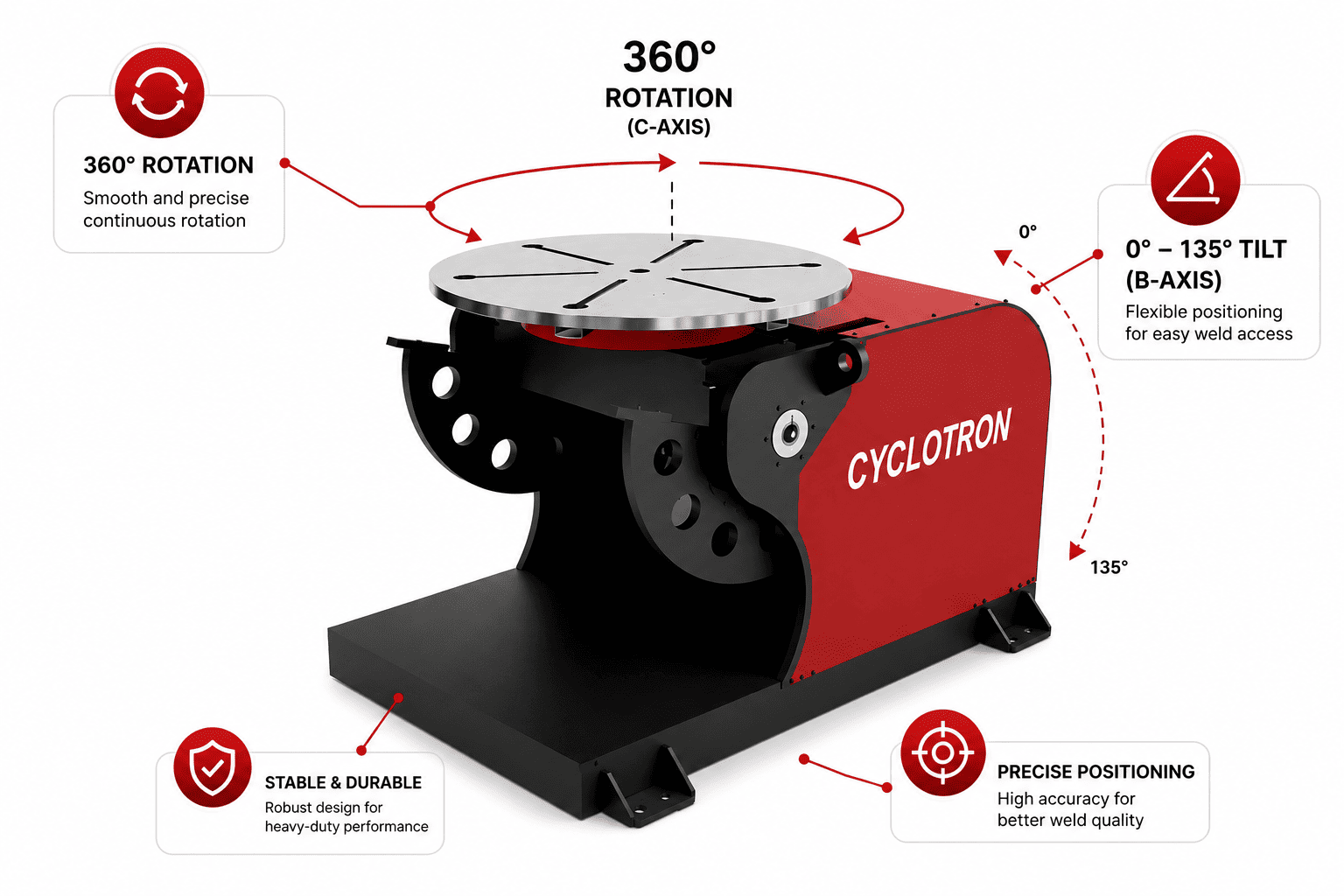
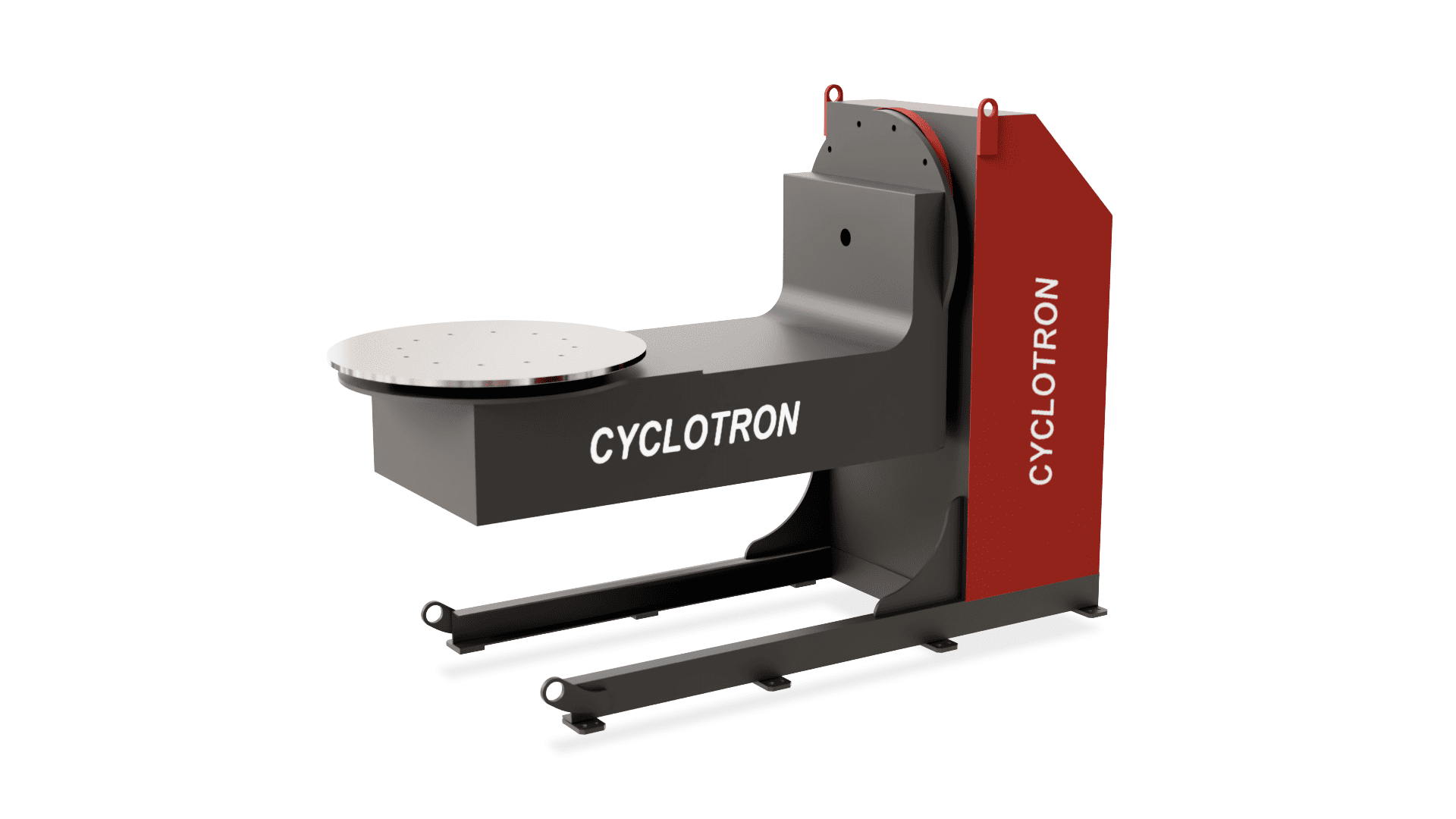
Best suited for complex fabrications, welding positioners are a perfect combination of tilt and rotation. This mechanical device gives complete access to handle the workpiece in optimal positions. Typically, welding positioners feature:
- 360° rotation
- Tilting capability (commonly 0–135°)
- Variable speed control
- Foot pedal or remote operation
It’s an ideal welding tool for repair facilities struggling with irregular components, such as nozzles, structural members, and flanges, at hard-to-reach angles. Here are some of the most common types of industrial welding positioners.
Parameters to consider while selecting Welding Positioner capacity
- Total load: Workpiece, fixture, clamps, and tooling
- Centre of gravity and eccentricity: Offset loads can increase torque and bending moments
- Dynamic effects: Starting, stopping, acceleration, and braking
- Tilting: Tilting creates a different load condition from rotation
- Duty cycle: Frequent operation can affect mechanical and thermal requirements
- Load holding: Braking and mechanical holding requirements
- Structural and drive components: Shafts, bearings, gearbox, table, and supports
- Applicable design standards: The required design margin depends on the specific machine and application
At Cyclotron Positioners, Fos 1.5 is the standard we follow. But for heavy-duty welding positioners above 15 tons we do keep 1.2 as factor of safety.
There is no single FoS value that applies to every welding positioner. The appropriate margin should be established from the actual load case, machine design and applicable engineering requirements.
Why Is Positioner Tonnage Alone Not Enough?
A balanced 5-ton load may be less demanding than an eccentric 3-ton load. Positioner selection should consider the complete load case:
Engineering input | Function |
Workpiece weight | Establishes the primary load |
Fixture/tooling weight | Adds to the actual operating load |
Centre of gravity | Determines how the load acts about the axis |
Eccentricity | Influences mechanical moment |
Rotational torque | Determines drive capability |
Tilting torque | Determines tilting-axis requirements |
Component envelope | Determines physical clearance |
RPM and duty | Influences drive and thermal requirements |
Load holding | Supports safe control of the assembly |
How Does Cyclotron Approach Welding Positioner Selection?
Cyclotron evaluates the application rather than relying on tonnage alone. The engineering review can consider the combined workpiece and fixture mass, CG position, eccentricity, required rotation and tilting moments, component envelope, required RPM and duty, fixture interface, and load-holding requirements.
Cyclotron’s published positioner specifications illustrate this multi-parameter approach by listing loading capacity with rotational torque, tilting torque, offset distance, speed, and dimensional limits.
Safety should also be treated as part of the machine design process, not as an afterthought. Machinery risk assessment frameworks such as ISO 12100 address hazard identification, risk estimation, and risk reduction during the machine life cycle.
What Information Should You Send for Positioner Sizing?
For an application-specific assessment, you are asked to provide:
- Workpiece weight
- Fixture and tooling weight
- Component drawing or 3D model
- Centre of gravity location, if known
- Maximum eccentricity or offset
- Required rotation and tilting angles
- Required RPM
- Production duty cycle
- Fixture interface details
- Required load-holding arrangement
The more detailed the load-case information is, the more accurately the positioner can be engineered for the application.
If you are selecting a welding positioner for a new fabrication, share your component drawing, 3D model, workpiece weight, and fixture details with Cyclotron for application-specific positioner sizing
Cyclotron Welding Positioners from India
Cyclotron manufactures industrial welding positioners from 100 kg to 100 Tons capacity, designed for robotic/manual welding, heavy fabrication, and high-production welding environments.
- Cyclotron manufactures all types of Manual/Robotic welding positioners like 1 axis, 2 axis, 3 axis, Headstock-tailstock, L Type, skyhook, etc
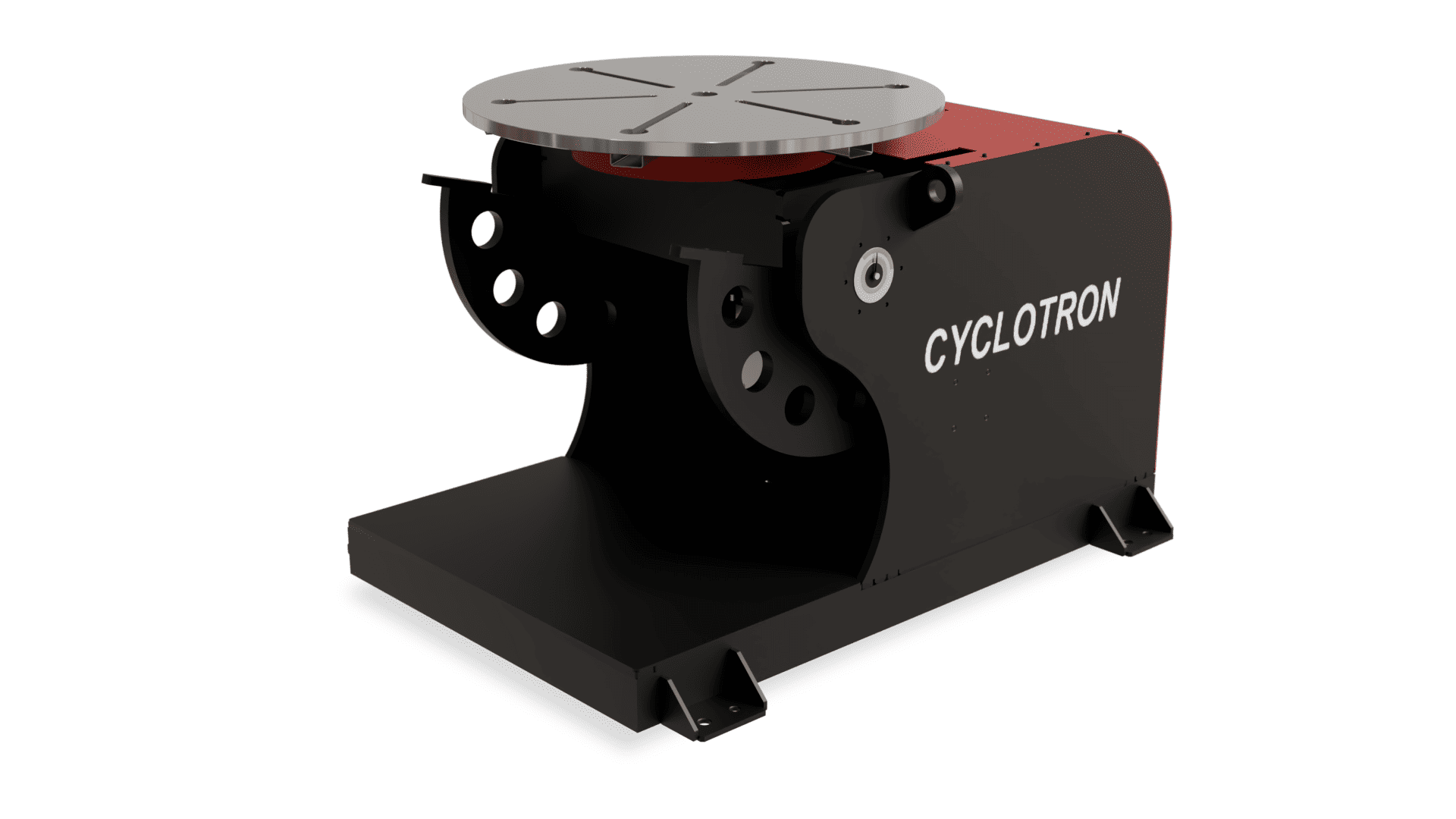
What is a welding positioner?
Its main purpose is to position the job at the best angle for welding, helping operators achieve better weld quality and greater efficiency.
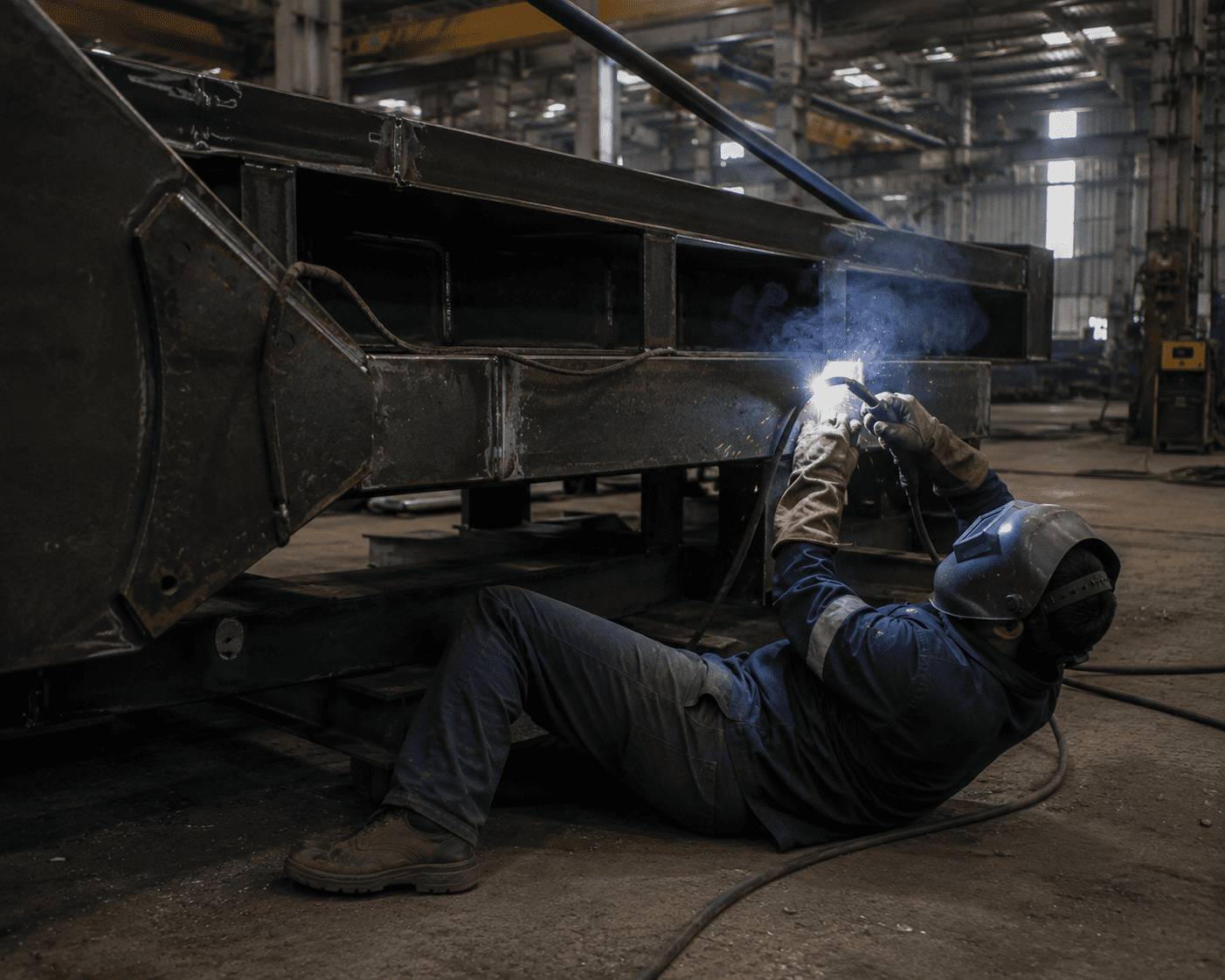
5 Common Welding Problems that a Positioner Can Solve
1. Poor weld quality due to welding positioners. 2. Excessive welder fatique 3. Longer welding cycle times, etc
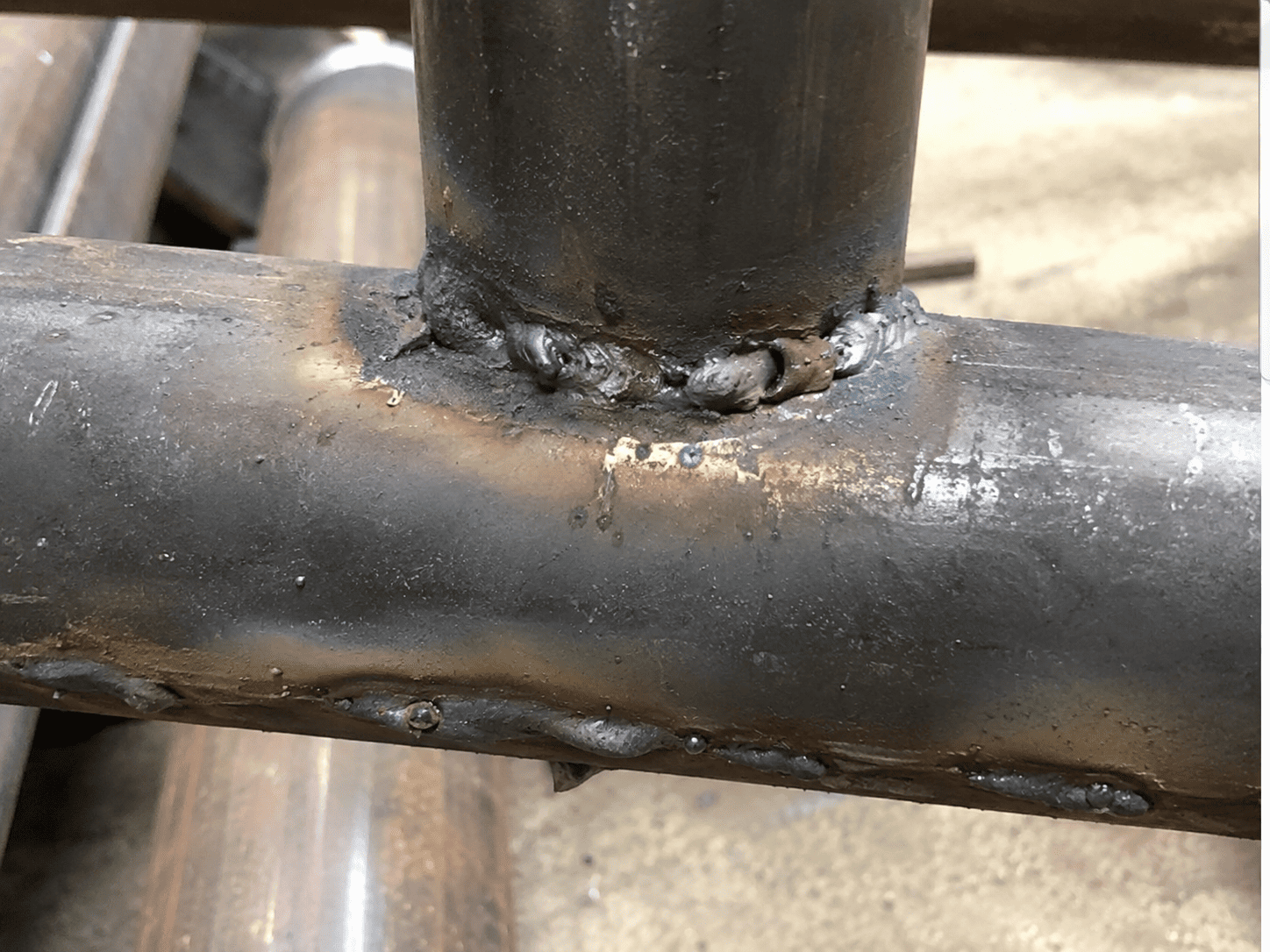
Inconsistent Welds- How a positioner can fix that
Welding positioner can help you with constantly changing weld angles, it can help you with operator fatique, etc
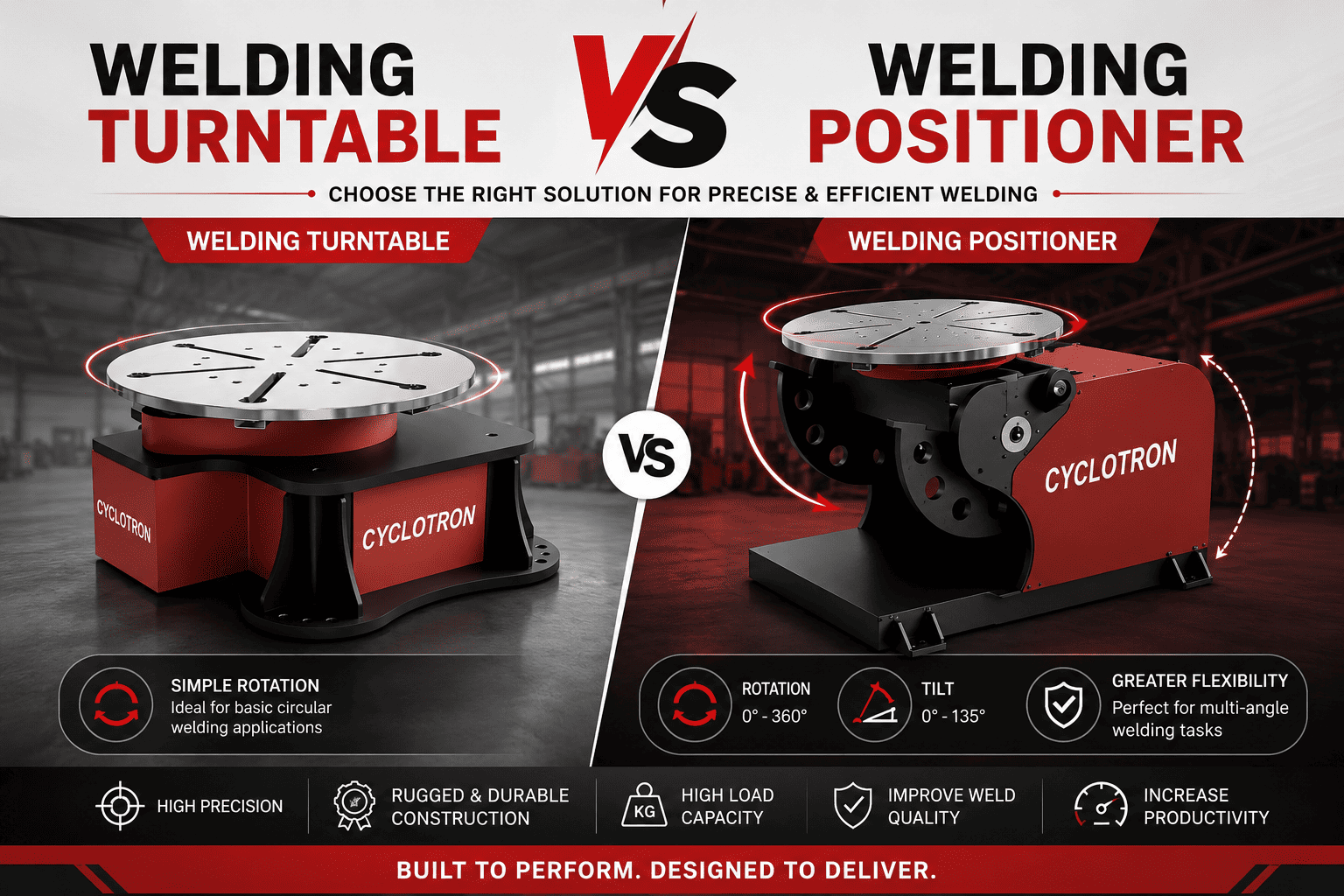
Welding Turntable vs Welding Positioner: What’s the Difference?
A welding turntable provides simple rotation for smooth, consistent welds. A welding positioner can also tilt and angle the workpiece,
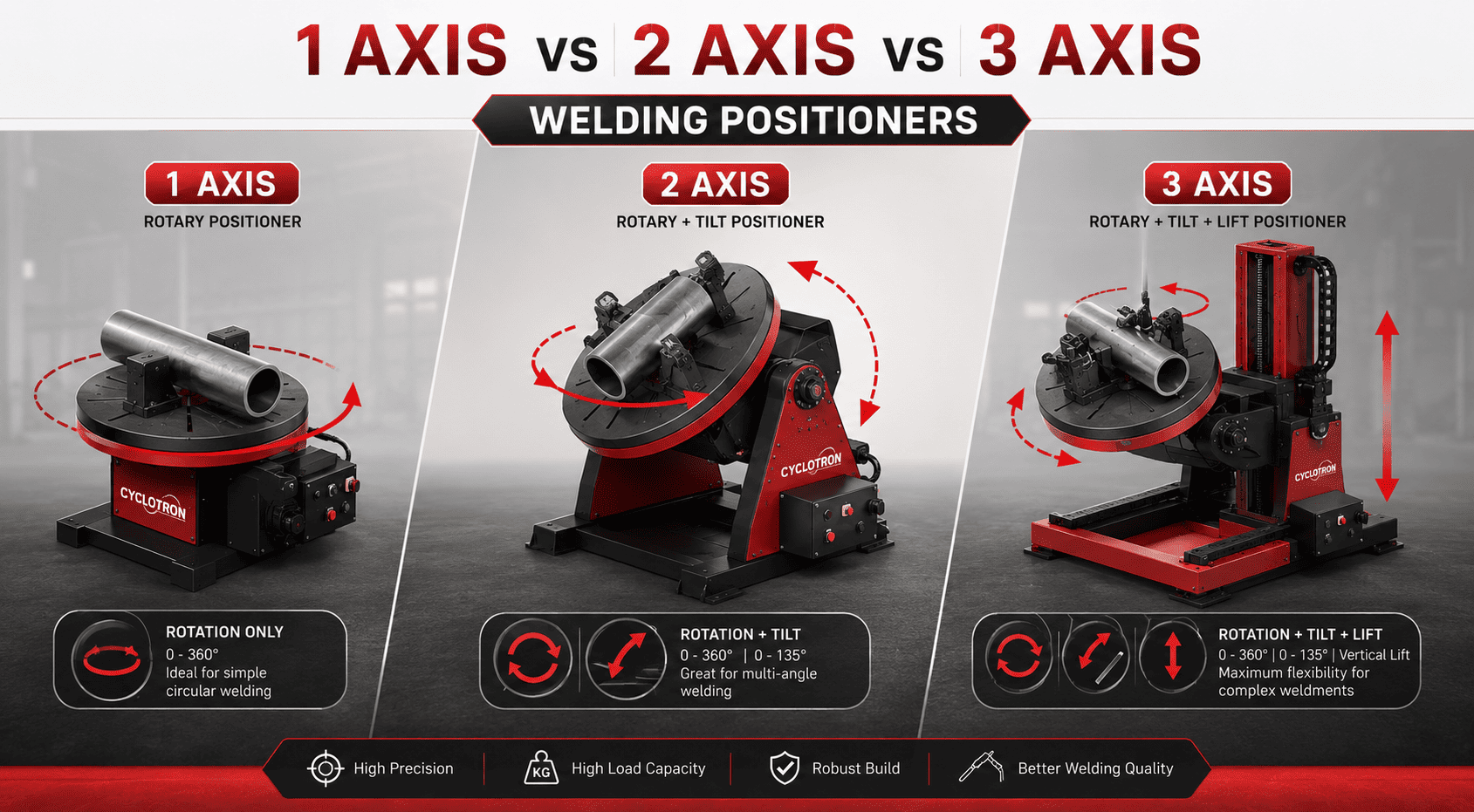
1 Axis vs 2 Axis vs 3 Axis Welding positioners
Compare 1 axis vs 2 axis vs 3 axis welding positioners based on rotation, tilt, flexibility, applications, cost, and automation. Learn which welding positioner is best for your fabrication needs.
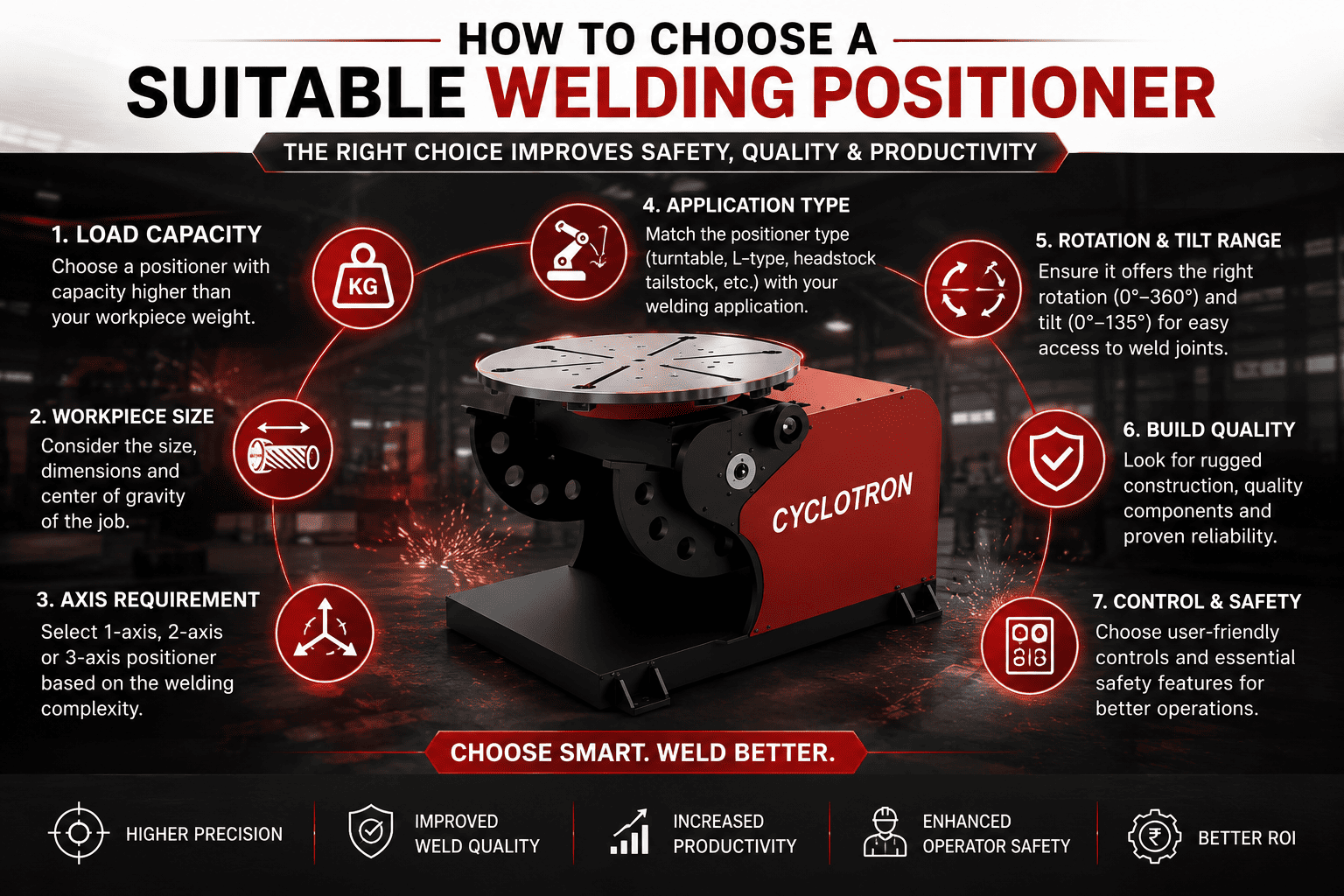
How to select a suitable welding positioner?
Selecting the right welding positioner plays a critical role in the fabrication setup. Welding positioners are designed to handle different load ranges.
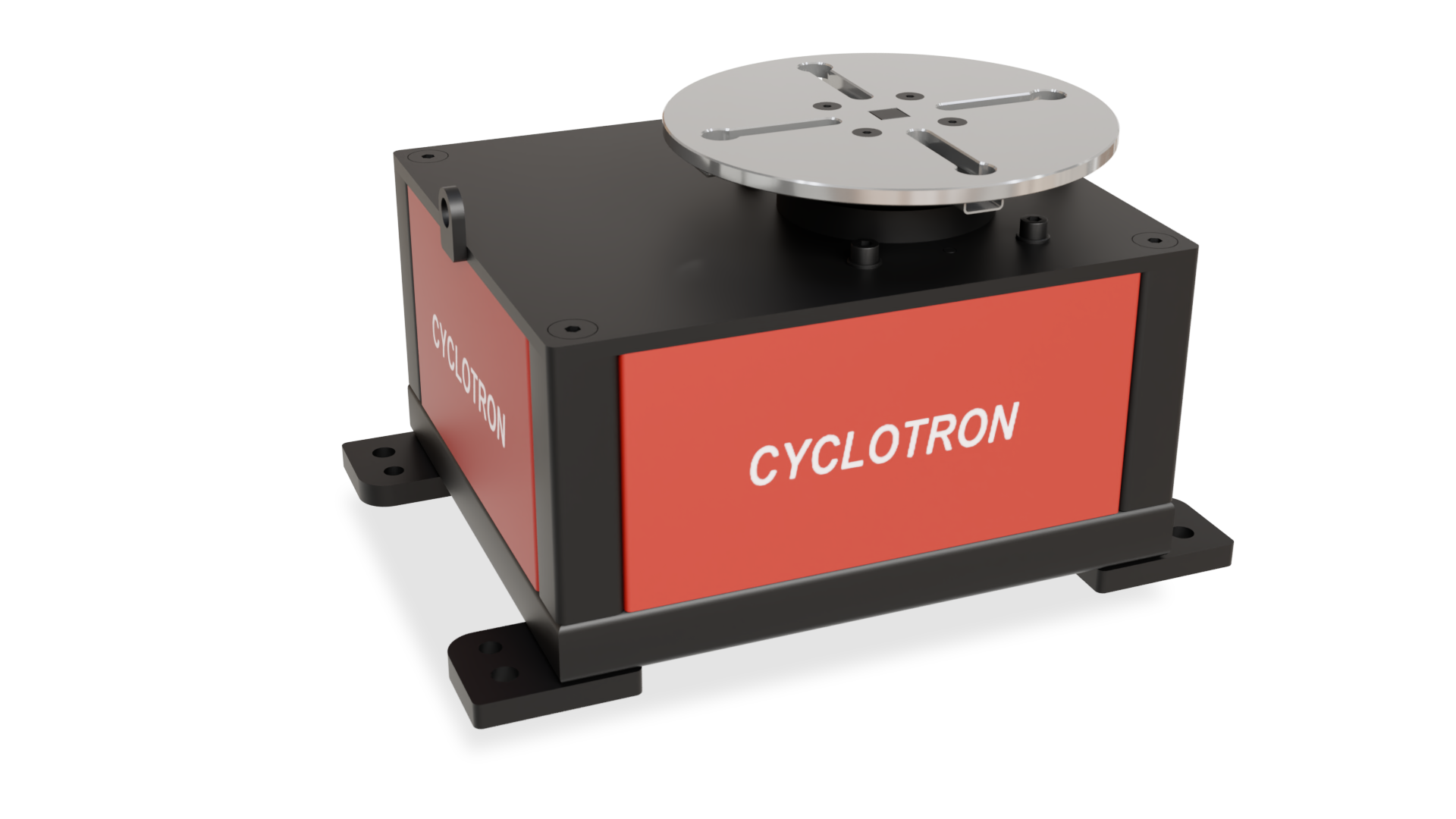
In this blog we will address all the commonly asked questions related to Welding positioners or Cyclotron Welding positioners specifically